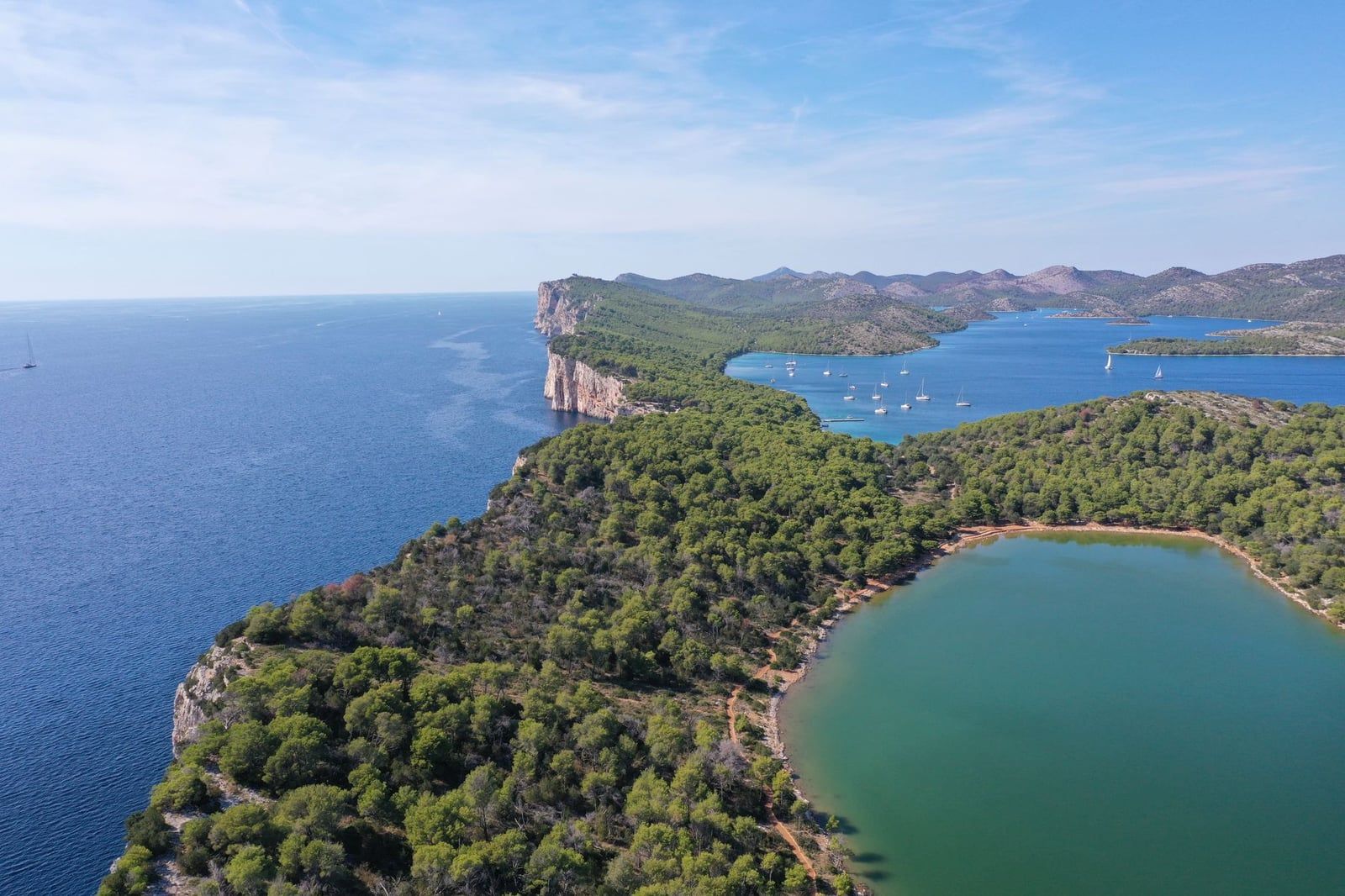
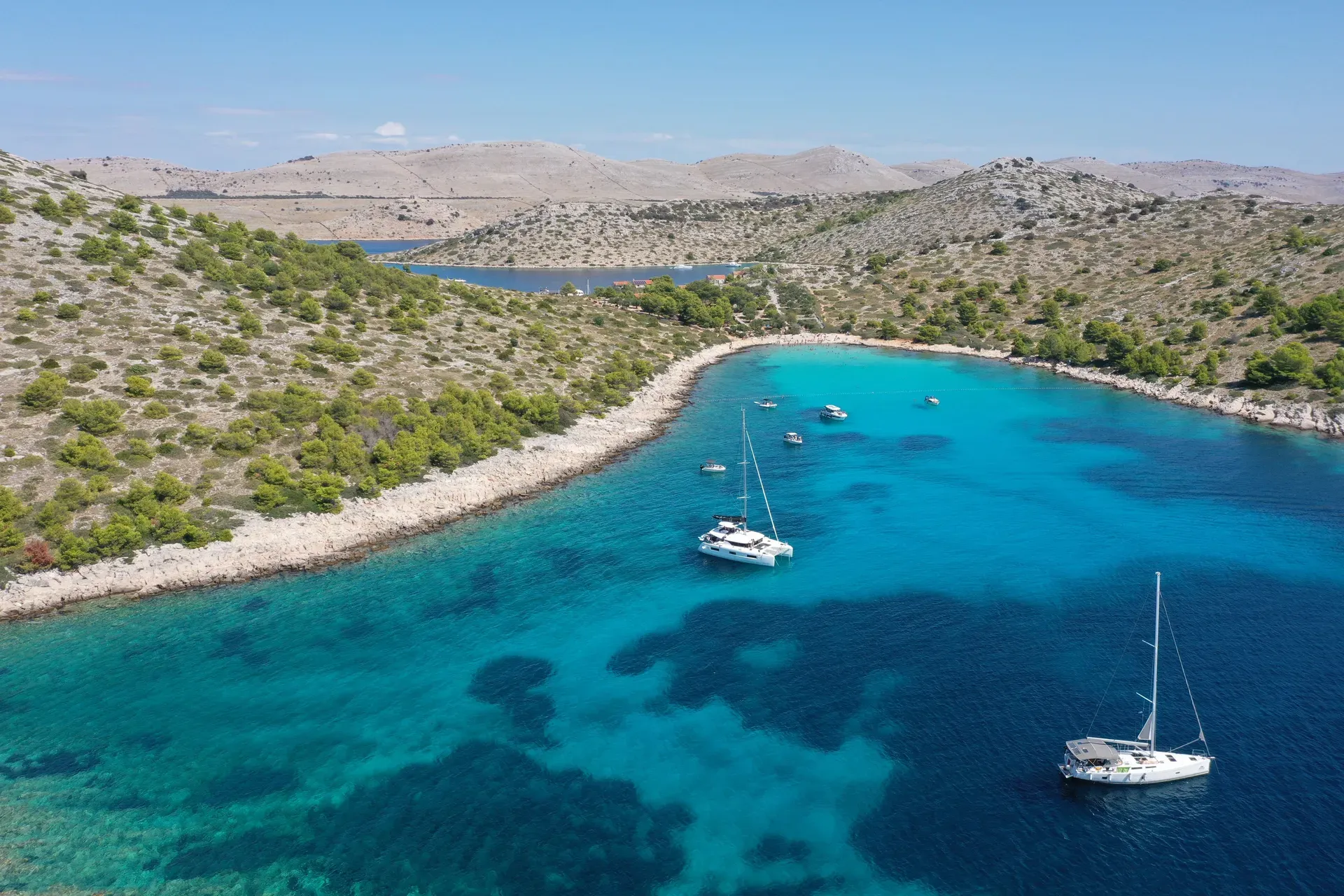
Eighty-nine treeless islands of white karst, water clear enough to count sea urchins six meters down, and no ferry to deliver the crowds — that is the snorkeling case for Kornati National Park, the densest archipelago in the Mediterranean. The park sits between Zadar and Šibenik in northern Dalmatia, and since every visit starts on a boat, a snorkel day here is really a boat day with your head in the water. Here is how to plan it.
Snorkeling in Kornati National Park at a Glance
Start with the answer: yes, you can snorkel in Kornati National Park, and you need no permit, licence, or certification to do it. Surface swimming with a mask is free everywhere except the four strict-protection zones (around the islet of Purara with the Klint and Volić reefs, Mrtenjak, Kolobučar, and the two Obručan islets), where boats may not even enter. What you do need is a valid park entrance ticket for every day on the water, whatever activity brings you there.
The water is the draw. Visibility often passes 30 meters, which puts the Kornati at the top of the Adriatic for clarity. Croatia's better-known snorkel stops — the Pakleni islets off Hvar, Vis, Mljet — have sandy beaches and easy shore access; the Kornati trade beaches for empty islands, vertical limestone walls, and water you can read the bottom of from the deck.
Timing and budget in one breath: go June through September, when the sea runs 20–27°C, and expect the ticket to cost either €25–45 per day for a small private boat or about €7 per person on an organized tour — usually already in the tour price. Since the park covers 217 km², roughly four-fifths of it sea, a full day among the islands is the standard visit. The rest of this guide fills in the gaps.
Why the Kornati Are Special Underwater
The islands are the visible edge of something much bigger. The Kornati "crowns" — fault cliffs on the outer, seaward side of the archipelago — rise more than 80 meters above the water on Klobučar and keep going below the surface, dropping over 90 meters at Piškera. Mana's wall reaches 65 m, Rašip Veliki's 64 m. Snorkeling here means floating along the top of a limestone face that vanishes into blue beneath your fins.
The karst continues underwater. Caves, tunnels, crevices, and overhangs riddle the reef line, and much of it is still unexplored — a rarity in a Mediterranean this heavily sailed. Above the waterline the islands are bare rock threaded with centuries of shepherds' dry-stone walls and a 6th-century Byzantine fortress on Kornat, all covered in our guide to the park itself.
Protection does the rest. Declared a national park in 1980, the archipelago records around 850 animal species, including 61 corals and 185 fish, on 353 algae species. Four decades without fishing pressure and development is why a short swim off any wall feels stocked rather than fished-out. And unlike scuba, none of it requires a licence — you bring a mask, or nothing at all if the tour provides one.
The Best Snorkeling Spots in the Kornati Islands
Every named spot below is reached from the water — there are no roads, and only one spot has anything you'd call a beach. Tours hit most of them; if you're on your own boat, note the anchoring guidance. Distances between them are short: the whole archipelago stretches about 35 km, so a day can cover three or four.
Levrnaka and Lojena Bay
Lojena is the archipelago's only real beach — a pale crescent of sand and fine pebble shelving into turquoise shallows, with Levrnaka's peak Veli vrh (118 m) behind it. It's the one spot with genuine shore snorkeling: walk in from the beach and follow the rock edges either side, where sponges and small caves start within a few strokes. Zadar half-day tours typically stop here for about 90 minutes. Expect company in July and August.
Mana
Mana pairs 65-meter cliffs with their underwater continuation — a steep wall that falls away below snorkeling depth within meters of the rock. Fish hold along the face, and the contrast between sunlit shelf and dark blue drop is the archipelago at its most dramatic. Mana is also one of the park's designated scuba zones, so dive boats share the bay; snorkelers stay on the surface and lose nothing for it.
Klobučar
A calm, shallow, rocky cove under 80-meter cliffs — the beginner and family pick. The water is sheltered from the afternoon breeze, the bottom stays visible, and there's enough small life in the rocks to keep young snorkelers interested without any depth to worry about. If you're traveling with kids who are new to a mask, make sure the tour stops here.
Opat
Opat is the confident snorkeler's stop: drop-offs close to shore and the park's most reliable sightings of large dusky groupers, fish that can pass a meter in length and show little fear of swimmers. You'll need to be comfortable finning over deeper water where the bottom disappears. Opat is also one of the 16 designated overnight anchoring bays, so it's reachable from your own boat without rule-breaking.
Ravni Žakan
The spot for structure: underwater caves, tunnels, and crevices where crustaceans and moray eels hold in the shadows. A seasonal konoba sits in the bay, so many full-day tours time a snorkel stop before or after lunch here. Bring a dive light if you have one — the caves reward it, and the openings are wide enough for a relaxed surface swimmer.
Piškera (Panitula) Reef
On Piškera's west side, right beside ACI Marina Piškera, a reef drops steeply into the depths and holds dense schools of fish — arguably the best single snorkel in the park. Marina guests reach it by dinghy; if you arrive by boat, anchor on the north side of the reef and swim the face. Piškera's cliffs top out at 45 m above the sea and fall more than 90 m below it, so the wall just keeps going.
Skrovada Cove on Lavdara
A sheltered cove on Lavdara island that works as a tour-boat swim stop when the wind pushes elsewhere. The shallows teem with small fish — salema, damselfish, juvenile seabream — making it the easiest "aquarium" experience for anyone nervous in open water. It's rarely a headline stop, which is exactly why it's calm.
One caveat worth knowing: many full-day tours out of Zadar also stop in Telašćica bay, on Dugi Otok. That's the adjacent nature park, a separate protected area with its own rules — superb swimming, but it isn't Kornati National Park, and the snorkeling there is a different, shallower proposition.
Marine Life You'll See While Snorkeling
The fish counts are real: 185 species recorded in the park, 61 corals, 177 molluscs, and 64 echinoderms. Along the walls you'll find chromis and damselfish holding in loose clouds, schools of salema shimmering over the reef, and wrasse working the rock. The walls do the work — fish hold along them for shelter, and the steeper the drop, the bigger the residents. Dusky groupers at Opat are the standard big sighting.
Look closer and the small stuff pays off. Octopus den in the rock piles, moray eels peer from holes in the caves at Ravni Žakan, sponges color the overhangs, and sea urchins line every crevice — one more reason for swim shoes. The Posidonia seagrass meadows are the park's nursery habitat and a good place to spot a seahorse if you move slowly.
With luck, bigger animals appear: bottlenose dolphins patrol the channels between the islands, and loggerhead turtles pass through in summer. Both are sightings you'll remember; neither is guaranteed. Everything you see is protected — take nothing, touch nothing, feed nothing. That habit keeps the rules section short-tempered and the reefs full.
Park Rules Every Snorkeler Must Know
Here's the distinction most guides blur: permits, zones, and depth limits apply to scuba diving, not to snorkeling. Surface swimming with a mask is permit-free everywhere in the park except the four strict-protection zones, where even swimming is banned. Night snorkeling is prohibited, full stop. On organized tours the operator handles everything else — but if you're steering your own boat, the conduct rules below apply to you.
- Nothing may be touched, fed, or collected — garbage excepted.
- Anchoring only in the 16 designated bays; park buoys are free with a valid ticket.
- Spear guns are prohibited throughout the park.
- Recreational fishing needs a park licence (€20 for one day, €40 for three) on top of the daily ticket.
- Hiking is allowed only on marked trails — all park land is privately owned.
Scuba is a different contract. Diving is legal only through licensed diving centers holding a park contract — most are based on Murter — in 9 designated zones (Opat–Tanka Prisliga, Samograd, Oključ, Mala and Vela Panitula, Rašip, Kasela, Mana, and Borovnik), to a maximum depth of 40 m, never between 19:00 and 07:00. The visiting-organizer fee is €15 per diver, and diving without permission draws a €400 fine. Snorkelers can ignore all of it.
Tickets & Fees: What a Snorkel Day Costs
Admission is charged per boat, per day — not per person. For private vessels bought in advance outside the park, a boat up to 6.99 m pays €25 in the off-season (January–May, October–December) or €45 in season (June–September); 7.00–10.99 m pays €30/€65, and 11.00–17.99 m pays €50/€95, rising steeply for larger craft. Buy the same ticket from the mobile ranger desks inside the park and the smallest class costs €45/€90 — roughly double. That's the strongest argument for buying online before you sail.
On organized tours the math changes. Contracted group boats pay per passenger — €7 per person in season, €3 off-season — and nearly all tours fold this into the advertised price, so you pay nothing at the gate. Kayaks and SUPs pay €7 per person daily. Two quirks worth knowing: guests at ACI Marina Piškera get the entrance ticket included with the regular berth fee (arrival day plus the next day until 19:00), and a 3-day combo ticket covering both Kornati and Telašćica costs €55 off-season / €110 in season for boats up to 6.99 m, sold through the mySea portal.
Advance tickets come from the park webshop (shop.np-kornati.hr), Parks of Croatia, mySea, or the ABA reception on Trg Rudina in Murter. A 1-day ticket is valid until 12:00 the following day. Tickets cannot be cancelled, and one date change per season is allowed by email ([email protected]) until 12:00 the day before your visit — so don't buy until your tour booking or weather window is firm.
Best Time to Snorkel the Kornati
June and September are the sweet spot: water at 20–24°C, visibility at its best, and a fraction of the July boat traffic competing for the same bays. July and August bring the warmest sea (25–27°C) and the most reliable tour departures, along with peak crowds and the year's highest prices. The season runs May to October on roughly 2,600–2,700 sunshine hours a year.
| Month | Water temperature | Visibility | Boat traffic |
|---|---|---|---|
| June | 20–23°C | Excellent | Moderate |
| July | 24–26°C | Excellent | High |
| August | 25–27°C | Excellent | Peak |
| September | 22–24°C | Very good | Low |
Time of day matters as much as month. Mornings are glassy; the Maestral, a northwesterly afternoon breeze, chops the surface from early afternoon onward and flattens the shallows' visibility. If your tour offers a choice, take the morning swim stop. November through March the day-tour fleet and the island konobas shut down entirely, and April, May, and October are possible but weather-dependent shoulder months.
Two winds can write off a day entirely. The bura, a cold gusty northeasterly and the park's most frequent wind, and the jugo from the southeast both cancel or reroute open-water crossings — winds of 6 Beaufort or more blow about 37 days a year. Check the marine forecast the evening before, book with operators who hold a fair-weather policy, and keep a spare day in your itinerary in shoulder season.
How to Get There: Gateways, Tours & Prices
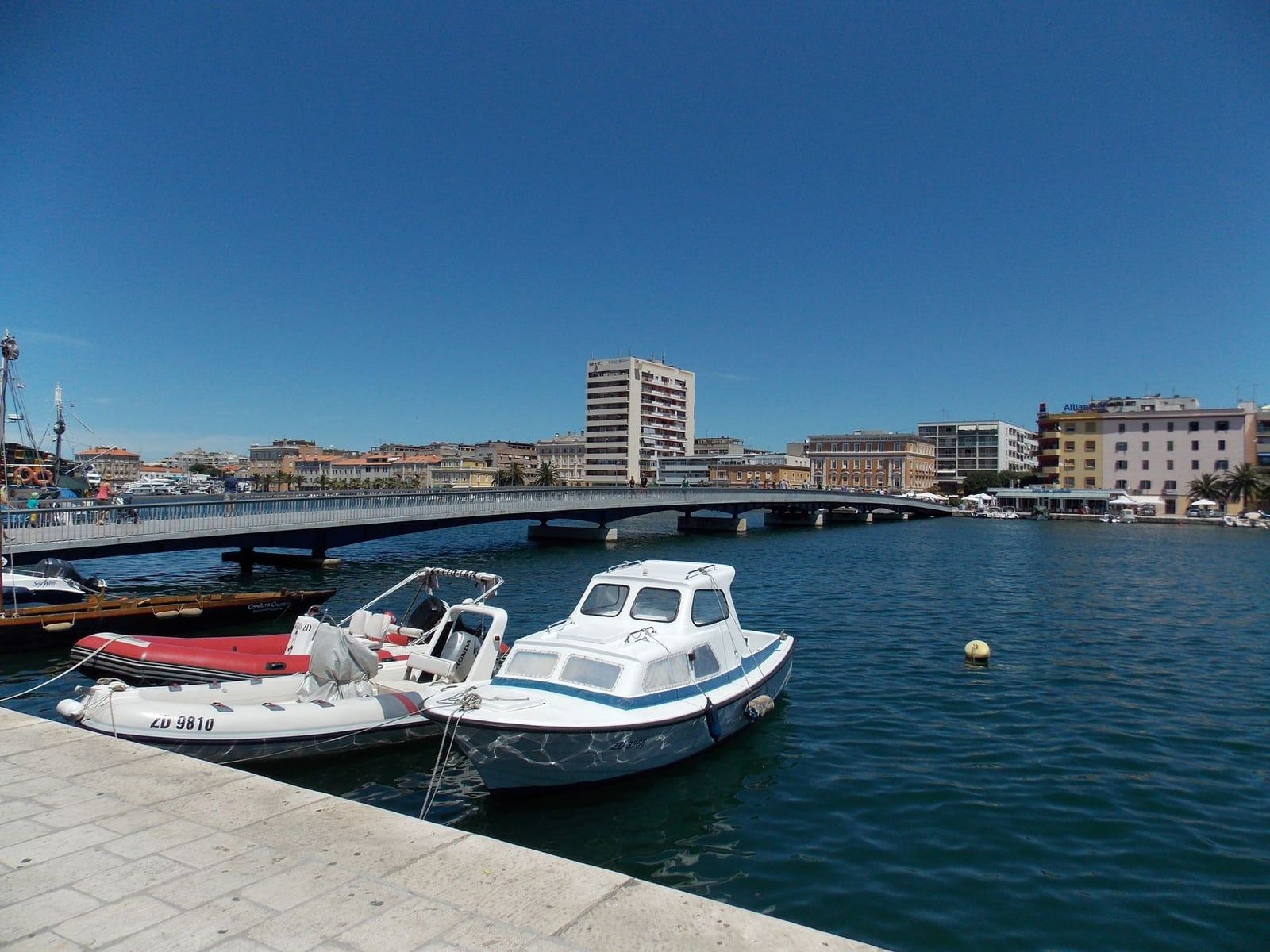
There is no scheduled ferry and no bridge — a boat is the only way in. For the full picture on how to get to the Kornati, the short version is a choice of gateways: Murter is closest at about 7 nautical miles (a 45–60 minute crossing), Biograd runs 1–1.5 hours, and Zadar and Šibenik sit about 15 nm out, roughly two hours each way. Vodice, Pakoštane, and Sukošan also send boats. Tours depart around 9:00 and return around 18:00.
| Format | Duration | Typical price | Includes |
|---|---|---|---|
| Half-day fast-boat snorkel trip | ~4–4.5 h | Varies by operator | Snorkel stops, all gear, guide |
| Full-day cruise | 8–10 h | €35–40 pp (Zadar ~€48–60) | Lunch, welcome drink, swim stops, park ticket |
| Private RIB charter | ~5 h or longer | ~€950 per boat (up to 11 guests) | Skipper, custom itinerary, park ticket |
| Own boat (DIY) | Your call | Ticket €25/€45 per day (under 7 m) | Free mooring buoys with valid ticket |
The half-day format is the pure snorkelers' choice: a fast boat, a long stop or two in the clearest bays, all gear provided, all ages welcome, no experience needed. Full-day boat tours trade snorkel time for the whole archipelago — cruising beneath the crowns, a konoba lunch, and two or three swim stops, with the park ticket and meal already in the €35–60 price. Groups who want to pick their own reefs should look at Kornati tours in the private charter category; a skippered RIB for up to 11 guests runs about €950 with the ticket included.
From Zadar specifically, tours from Zadar lean full-day and usually fold in Telašćica on Dugi Otok alongside the Kornati swim stops. Going DIY? Buy your ticket online before entering the park, use the free buoys rather than anchoring outside the 16 designated bays, and bring your own gear — there's no rental operation inside the park beyond what the tours carry.
Snorkeling Gear & Safety Checklist
Fit beats brand. A silicone mask with tempered glass that seals without a strap, a dry-top snorkel that shuts out chop, and adjustable fins you can wear barefoot or over thin boots — that's the whole kit. Water sits at 20–27°C from June to September, so most snorkelers are fine in a rash guard; a 2–3 mm shorty wetsuit earns its place in June and September, when 20–24°C water cuts sessions short after half an hour.
Sun is the bigger hazard than the sea. The islands are shadeless karst with roughly 40 hot days (30°C plus) a year and no drinking water supply, so a hat, reef-safe sunscreen, a UV shirt, and more water than you think you need are the real essentials. Swim shoes matter too — sea urchins line the rocks at nearly every spot above.
- Never snorkel alone; keep the boat in sight.
- Carry a float or surface marker in open water.
- Check the marine forecast every morning.
- Enter from a boat ladder feet-first, clear of the prop.
- Keep children in shallow coves with flotation and supervision.
For kids and beginners, Klobučar's shallow cove and Lojena's beach are the right first stops, and half-day tours advertise all ages with no experience required. One thing to plan around: there is no medical facility anywhere in the park. The nearest first aid stations are in Murter and Sali on Dugi Otok, and rescue response across an archipelago takes time — swim inside your limits and call 112 in an emergency.
FAQs About Snorkeling in Kornati National Park
Is snorkeling allowed in Kornati National Park?
Yes — surface snorkeling is allowed and permit-free throughout the park except the four strict-protection zones, where swimming is banned. Every visitor needs a valid park entrance ticket: €25/€45 per day for a private boat up to 6.99 m bought in advance, or about €7 per person on a contracted group tour, usually included in the tour price.
Do you need a permit or certification to snorkel in the Kornati?
No. Permits, the 9 designated zones, the 40 m depth limit, and the licensed-center requirement apply to scuba diving only. Night snorkeling is the one restriction on the surface side — it's prohibited. Scuba divers additionally pay a €15 per-diver fee.
How much do Kornati National Park tickets cost?
Tickets are per boat, per day: €25 off-season / €45 in season (June–September) for boats up to 6.99 m, €30/€65 for 7–10.99 m, and €50/€95 for 11–17.99 m, all bought outside the park. Inside the park, ranger desks charge more (€45/€90 for the smallest class). Kayaks and SUPs pay €7 per person daily, and a 3-day Kornati + Telašćica combo costs €55/€110 for small boats via mySea.
What are the best snorkeling spots in the Kornati?
Lojena Bay on Levrnaka for shore entry, Mana's underwater cliff wall, Klobučar's sheltered shallow cove, Opat's drop-offs with large dusky groupers, the caves and tunnels at Ravni Žakan, the steep reef on Piškera's west side next to ACI Marina Piškera (anchor north of the reef), and Skrovada Cove on Lavdara for calm, fish-filled shallows.
When is the best time to snorkel in the Kornati?
June through September, when the water is 20–27°C and visibility is at its best — often beyond 30 meters. June and September deliver the same clarity with fewer boats than July and August. Within a day, mornings are calmest before the afternoon Maestral breeze chops the surface.
How do I get to the Kornati for a snorkeling day trip?
By boat only — there's no ferry. Organized tours run from Murter (45–60 min crossing), Biograd (1–1.5 h), Zadar (about 2 h), Šibenik, Vodice, and Pakoštane, costing roughly €35–60 per person for a full day with lunch and the park ticket included. Private half-day snorkel charters of 4–5 hours with gear provided also operate.
Is Kornati snorkeling good for beginners and kids?
Yes. No experience is needed, tours provide all gear, and half-day trips welcome all ages. Shallow, calm coves like Klobučar and Lojena suit children — just watch them on rocky shorelines, as there's no medical facility inside the park.
Can you snorkel from the beach in the Kornati?
Rarely. Most of the islands are uninhabited rock with no beaches, so the standard day is boat-to-water. Lojena on Levrnaka is the main shore option, and guests at ACI Marina Piškera can dinghy across to the nearby reef on the island's west side.
Sources
- np-kornati.hr/index.php?Itemid=404&id=326&lang=en&option=com_content&view=articl
- np-kornati.hr/index.php?id=432&itemid=414&lang=en&option=com_content&view=articl
- np-kornati.hr/index.php?option=com_content&view=article&id=60&Itemid=225&lang=en
- np-kornati.hr/index.php?option=com_content&view=article&id=59&Itemid=248&lang=en
- np-kornati.hr/index.php?option=com_content&view=article&id=81&Itemid=281&lang=en